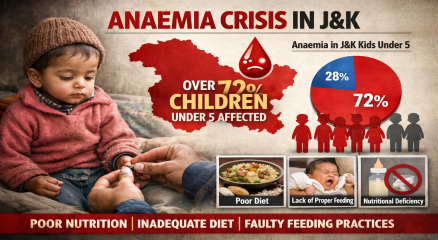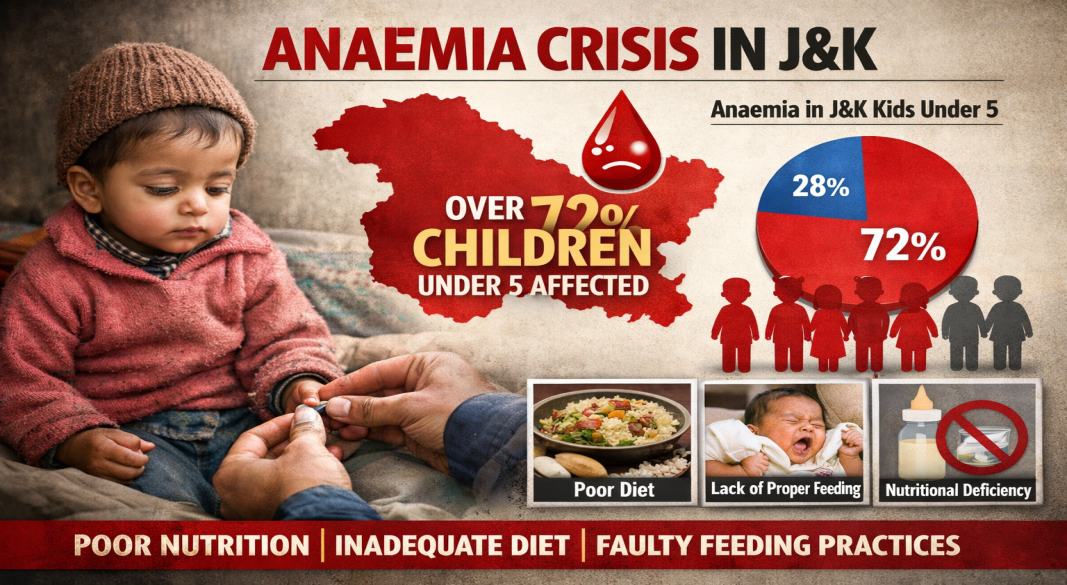
Srinagar, Jan 10: Over 72% of children under the age of five are suffering from anaemia in Jammu and Kashmir, one of the highest rates in the country.
Experts warn that this alarming trend poses serious risks to the growth, immunity, and development of the region’s youngest population.
As per the 'Children in India 2025' report by the Ministry of Statistics and Programme Implementation, 72.7 per cent of children, including 73.9% male and 71.4% females, are anaemic in J&K which includes 73.5 per cent in rural areas and 70.1 per cent in urban areas.
Doctors termed it a serious public health concern.
"When a child is anaemic, their blood lacks enough healthy red blood cells or haemoglobin needed to carry oxygen throughout the body," the doctors said.
"This leads to fatigue, weakened immunity, delayed growth, impaired brain development, lowered learning ability, and increased risk of infections," they said.
Dr Shabeena Shah, a child specialist, said the most common cause of anaemia worldwide and in India is nutritional deficiency, especially iron deficiency.
"Young children have high iron needs for rapid growth, but many diets do not supply enough iron or other vital nutrients like folate and vitamin B12," she said.
"Iron Deficiency Anaemia (IDA) is the predominant form responsible for a large share of anaemia cases in toddlers and young children."
According to the doctor, a diet too reliant on staple grains without enough iron-rich foods (like leafy greens, lentils, eggs, meat, fortified cereals) worsens this deficiency.
She said the children whose mothers are anaemic themselves are more likely to be anaemic.
Low maternal iron stores during pregnancy limit the amount of iron the baby receives before birth and through early infancy, Dr Shah added.
Dr Showkat Hussain, another doctor, said that after six months of age, breast milk alone is not enough to meet a baby’s iron requirements.
He said that if complementary foods aren’t introduced properly or are low in iron, the risk of anaemia increases.
He added that parasitic infections like hookworm and other gastrointestinal infections can cause blood loss and reduce nutrient absorption, contributing significantly to anaemia.
Dr Hussain added that inclusive breastfeeding for the first six months provides optimal nutrition and helps build immunity. "Breast milk contains iron that is easily absorbed by infants, helping protect against anaemia in early infancy.
However, after 6 months, iron stores from birth get depleted, and complementary foods need to be introduced. If the complementary diet lacks iron-rich foods, anaemia risk rises," he added.
Doctors said that inadequate complementary feeding, such as giving mostly watery cereals or liquid foods without iron enrichment, can worsen anaemia.
They added that eating fried or junk foods does not directly cause anaemia, but it contributes indirectly by displacing nutritious foods in a child’s diet, providing empty calories with little iron, vitamins, or minerals.
Doctors called for introducing iron-rich complementary foods after six months, such as meat, eggs, green leafy vegetables, lentils, beans, pair iron foods with vitamin C-rich foods (like citrus fruits, tomatoes) to improve iron absorption and avoid overreliance on packaged snacks and fried foods.
They said the government programmes, such as Anaemia Mukt Bharat and Mission Poshan 2.0, provide iron and folic acid supplements for children and mothers.
The weekly iron supplementation and fortified foods can substantially reduce anaemia prevalence, the doctors said, adding that routine deworming and immunisation help reduce anaemia caused by parasites and infections. (KNO
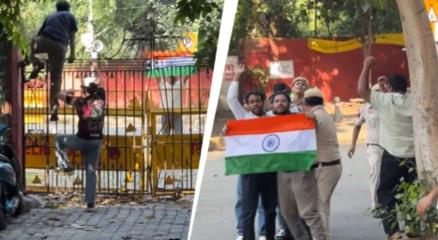
New Delhi, May 12: A massive protest organised by the National Students' Union of India (NSUI) broke out near the Shastri Bhawan on Tuesday, against the alleged paper leak in NEET-UG this year. The exam was held on May 3, following which allegations of paper leak surfaced, triggering investigations by the Rajasthan Special Operations Group (SOG) and central agencies. Earlier, the National Testing Agency (NTA) announced the cancellation of NEET-UG 2026, and said the examination will be re-conducted on dates to be notified separately. In a statement, the NTA said the decision was taken with the approval of the Government of India in the interest of maintaining transparency and preserving trust in the national examination system.
Srinagar, Feb 12: Jammu and Kashmir recorded over 15.48 lakh traffic violation cases in 2025, with authorities collecting more than Rs 34.17 crore as penalty under the Motor Vehicles Act, the Centre informed Parliament on Thursday. The information was shared in the Lok Sabha in response to a question raised by MP Janardan Singh Sigriwal. According to the official data, 15,48,525 challans were issued across the Union Territory in 2025, while the penalty amount recovered stood at Rs 34,17,36,740. The figures further show that in 2024, a total of 15,44,105 violations were registered with a penalty collection of around Rs 43.40 crore, while in 2023, 12,38,584 challans were issued and Rs 34.56 crore was collected. For the current year, till February 8, 2026, Jammu and Kashmir has recorded 1,63,531 traffic violation cases, with revenue collection of about Rs 2.11 crore. The Ministry of Road Transport and Highways stated that stricter penalties under the Motor Vehicles (Amendment) Act, 2019 are aimed at ensuring better compliance and deterrence. It also said that traffic enforcement falls under the jurisdiction of States and Union Territories. The government has issued a Standard Operating Procedure (SOP) for electronic monitoring and is promoting technology-driven enforcement through Automatic Number Plate Recognition (ANPR) cameras integrated with the VAHAN database. Awareness campaigns under the Sadak Suraksha Abhiyan are also being carried out to improve road safety.
New Delhi, Jan 25: The Dental Council of India (DCI) has directed all universities and dental colleges across the country to strictly ensure a minimum of 80 percent biometric attendance for Post Graduate students before allowing them to appear in examinations. The decision has been taken to curb absenteeism among postgraduate dental students. According to a circular issued by the Dental Council of India-a statutory body under the Ministry of Health and Family Welfare, Government of India, the decision has been taken after multiple complaints were received from dental colleges in Rajasthan, Haryana and Uttar Pradesh regarding non-attendance of PG students. "The matter was examined by the Grievance Sub-Committee of the DCI in its meeting held on November 24, 2025," the circular reads. It reads that after detailed discussion and deliberation, the committee recommended that all universities and dental colleges must ensure compliance with Regulation 18(a)(i) of the DCI Master of Dental Surgery Course Regulations, 2017, which mandates at least 80 per cent attendance. "The recommendation of the Grievance Sub-Committee has been approved by the Executive Committee of the Dental Council of India through circulation and has now been formally communicated for information and necessary action," the circular reads. As per the circular, all the universities and dental colleges have been directed to ensure minimum 80 per cent biometric attendance of all PG students before permitting them to appear in examinations. The order, issued by Deputy Secretary Dental Council of India Mukesh Kumar, is expected to be implemented with immediate effect across the country.
Srinagar, Jan 8: Contractual faculty members working in government degree colleges of Jammu and Kashmir Higher Education Department (HED) have expressed strong resentment over what they term as a glaring disparity in salaries, demanding revision of their pay in line with University Grants Commission (UGC) norms and regularisation of their services. The faculty, many of whom hold PhDs and are qualified through NET, SET and JRF, said they have been denied UGC-recommended pay scales despite discharging academic responsibilities equivalent to their regular counterparts. “Hundreds of highly qualified scholars have been pushed into silent suffering. For years, we have been assured that our pay revision is under consideration, but nothing has materialised so far,” said Dr Ishfaq Gowhar, a contractual faculty member. Earlier, Director Colleges J&K had acknowledged the legitimacy of the faculty’s demand, stating that while the issue was genuine, its implementation involved significant financial implications due to the large number of contractual appointments. “We are aware that they deserve salary enhancement, but the number of contractual faculty is huge and it has financial implications,” he earlier said. Dr Gowhar pointed out that contractual lecturers, who form the backbone of the higher education system, continue to work on a fixed monthly honorarium of Rs 28,000, which has remained unchanged for nearly a decade. “The irony is that a Class IV employee with a Class 10 qualification draws a salary exceeding Rs 50,000, while doctorate-holding teachers engaged in teaching, mentoring and academic research are paid a fraction of that,” he said. He added that institutions such as SKUAST-K, University of Kashmir and Islamic University of Science and Technology (IUST) have implemented revised UGC pay scales, but the Higher Education Department has failed to extend similar treatment to its contractual faculty. Dr Gowhar said the demand for “equal work, equal pay” gets prominently featured in election campaigns, raising hopes among contractual teachers. “Promises were made and slogans echoed during elections, but once the process ended, our voices were reduced to silence. Even meeting officials now feels impossible,” he said. He said contractual faculty were not seeking privileges but dignity, fairness and recognition for their service. The faculty appealed to the Jammu and Kashmir Lieutenant Governor Manoj Sinha, Chief Minister Omar Abdullah and the Education Minister to intervene and take concrete steps towards addressing their long-pending demands. “This issue is not merely about salaries. It is about survival, justice and dignity in the classrooms of Jammu and Kashmir,” he said.
Srinagar, March 6: Around 17 candidates from Jammu and Kashmir have qualified the Civil Services Examination (CSE)-2025, the result for which was declared by the Union Public Service Commission (UPSC) on Friday. The commission recommended a total of 958 candidates for appointment to the Indian Administrative Service (IAS), Indian Foreign Service (IFS), Indian Police Service (IPS) and various central services. Anuj Agnihotri, an MBBS graduate, has topped the civil services examination 2025, while Rajeshwari Suve M and Akansh Dhull have got the second and third ranks respectively. According to the official list released by the UPSC the 17 candidates from J&K who have figured in the final merit list include Suvan Sharma (Rank 148), Sugandha Gupta (207), Towseef Ganie (Rank 254), Ritika (Rank 456), Sooyash Shivam (Rank 572), Muneeb Parrah (Rank 581), Ghulam Din (Rank 683), Dwarka Gaadhi (Rank 721), Akash (Rank 747), Koh E Safa (Rank 763), Yasaar (Rank 811), Abhishek (Rank 820), Pankaj (Rank 856), Mohammad Ajaz (Rank 869), Azhar (Rank 886), Sarfraz (Rank 936), and Irfan (Rank 957). The results were declared after conducting the written examination in August 2025 followed by the personality tests (interviews) conducted between December 2025 and February 2026. As per the result notification issue by the UPSC, a total of 958 candidates have been recommended for appointment against 1087 vacancies reported by the government for the examination cycle. These include 180 vacancies in the IAS, 55 in the IFS, 150 in the IPS, 507 in Central Services Group A and 195 in Group B services. Of the total recommended candidates, 317 are from the general category, 104 from the economically weaker sections, 306 from other backward classes, 158 from scheduled castes and 73 from scheduled tribes. A consolidated reserve list of 258 candidates has also been published in accordance with the rules. The claims of recommended candidates regarding reservation categories will be subject to verification by the concerned authorities. The UPSC has stated that the candidature of 348 recommended candidates has been kept provisional, while the result of the two candidates has been kept withheld. The CSE is conducted annually in three stages- preliminary, Mains and interview by the UPSC to select officers of the Indian Administrative Service (IAS), Indian Foreign Service (IFS) and Indian Police Service (IPS) among others. The civil services (preliminary) examination 2025 was conducted on May 25 of 2025. A total of 937876 candidates applied for this examination, out of which 5,76,793 actually appeared in the test. A total of 14,161 candidates qualified for appearance in the written (Main) examination which was held in August, 2025. Of these, 2736 candidates had qualified for the personality test (interview) of the examination. Prime Minister Narendra Modi congratulated the candidates who qualified the UPSC exam. "Congratulations to all those who have successfully cleared the Civil Services Examination, 2025. Their dedication, perseverance and hard work have led to this significant milestone. Wishing them the very best as they embark on a journey of serving the nation and fulfilling the aspirations of the people," PM Modi wrote on his official X handle. "To those who may not have secured the desired outcome in the Civil Services Examination, I understand that such moments can be difficult. However, this is only one step in a larger journey. Many opportunities lie ahead, both in future examinations and in the many avenues through which you can contribute to our nation. My best wishes for the road ahead," his post on X reads. UPSC chairman Ajay Kumar announced the declaration of the result and congratulated the candidates who qualified the exam. "Congrats to all successful candidates as you begin a career of service to the nation. For those who did not make it-the learning from this journey will guide you in the paths ahead," UPSC Chairman wrote in a post on X. Among the 17 candidates from J&K who qualified UPSC exam inlcude a visually impaired candidate Irfan Ahmad Lone, a resident of Manzpora in the Naidkhai area of Bandipora.


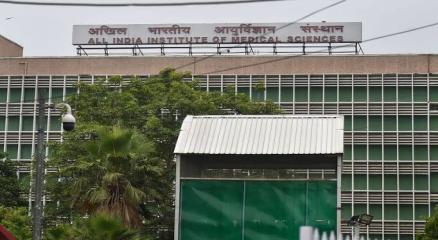
New Delhi, Sep 19: Metabolic surgery could help achieve remission of type-2 diabetes in a selected few patients, and better blood sugar control in many when the disease remains uncontrolled despite appropriate medical treatment, a senior AIIMS doctor said. Dr Manjunath Maruti, professor in the Department of Surgery said the procedure should not be viewed as a treatment for every person with diabetes, but as one of the evidence-based options for patients whose blood sugar remains uncontrolled despite medicines and lifestyle changes. "For some patients medication and lifestyle modification will be sufficient. For others, despite appropriate medical therapy, diabetes would remain uncontrolled. In these patients, metabolic surgery may provide an opportunity to achieve remission, and in some, much better glycaemic control" Dr Manjunath said. According to the protocol followed by his unit, metabolic surgery may be considered when a patient's HbA1c, a measure of average blood sugar, remains above 7.5 per cent despite treatment with more than three oral anti-diabetic medicines, with or without a GLP-1 receptor agonist or insulin. The patient should also have been living with type-2 diabetes for at least two years. Surgery may also be considered when a patient has been advised or started on insulin because medicines are no longer sufficient to control blood sugar, he said. Another important indication is the presence of early diabetes-related organ damage, irrespective of the HbA1c level, Dr Manjunath said. This could include protein or albumin in the urine, suggesting early kidney damage; pain in the legs while walking due to reduced blood flow; heart related chest pain or a history of angioplasty or stent placement indicating heart disease; a transient ischemic attack or stroke; or reduced vision caused by diabetic eye disease. "In simple terms, uncontrolled diabetes means diabetes that remains inadequately controlled despite more than three medicines, or when insulin was started, or when diabetes has already started causing damage to important organs," he said. Dr Manjunath said the upfront cost of metabolic surgery need to be weighed against the substantial long-term health and economic burden of uncontrolled diabetes. Over time, diabetes can cause complications such as kidney failure requiring dialysis or transplantation, heart disease requiring procedures or bypass surgery, diabetic retinopathy requiring laser treatment, peripheral vascular disease that may require surgery or, in severe cases, amputation, and stroke requiring prolonged hospitalisation. "No treatment can guarantee that these complications will never occur. But sustained improvement in metabolic health following metabolic surgery has the potential to reduce the long-term burden of diabetes and its complications," he said. The decision, he said, should therefore take into account not only the immediate cost and risks of surgery but also the possible long-term consequences of living with uncontrolled diabetes. Dr Manjunath stressed that prevention should remain the starting point in tackling diabetes, with healthier food choices, regular physical activity, adequate sleep and early identification of metabolic disease. Patients who develop diabetes should have timely access to effective medical treatment, while those whose disease remains uncontrolled despite appropriate therapy should be assessed by a multidisciplinary diabetes and metabolic surgery team, he said. For appropriately selected patients, metabolic surgery can form part of the modern treatment approach, provided it is carried out by an experienced team at a dedicated centre with structured follow-up, he added. Dr Manjunath said his unit's experience of treating 67 patients with uncontrolled type-2 diabetes, including 18 patients with a body mass index (BMI) of 23-35 kg/m2 and 15-25 years of diabetes, highlights the potential role of metabolic surgery in such patients. However, long-term prospective follow-up would be important to determine how durable diabetes remission and metabolic improvements are after surgery, he said. "Do not wait for diabetes to damage the organs before you intensify treatment," Dr Manjunath said. "Metabolic surgery is not for everyone but for the right patient, at the right time, it can be transformative." (PTI)




Srinagar, Feb 18: The Jammu and Kashmir Government on Wednesday informed the House that out of 877 ventilators installed across hospitals in the Union Territory, 219 remain non-functional, highlighting gaps in critical care infrastructure. Replying to a question of MLA Shamim Firdous, minister in-charge for Health and Medical Education Department informed the House that 658 ventilators are functional while 219 are non-functional. While giving institution-wise details, she said that in GMC Jammu and its associated hospital there are 320 ventilators, among which 209 are functional and 111 are non-functional. “In SMHS Srinagar, 08 ventilators are non-functional and in GMC Srinagar associated hospitals excluding SMHS, 44 are non-functional,” the government said. As per the figures, in GMC Anantnag only 10 out of 36 ventilators are functional while GMC Baramulla has 2 non-functional ventilators and GMC Doda 10, GMC Kathua 2 and GMC Rajouri 3 are non-functional as well. Also, in GMC Udhampur and GMC Handwara, all 39 and 6 ventilators respectively are functional. The government further said, in SKIMS and its associated hospitals, out of 53 ventilators, 40 are functioning while 13 are non-functional.

Washington, Jan 20: Widespread smartphone and social media use among children is driving a sharp rise in depression, anxiety and suicide, top American lawmakers and experts have said calling it a public health crisis that demands urgent government action. Parents are increasingly alarmed by the amount of time children spend on screens and the nature of the content they consume, said Senator Ted Cruz, during a Senate Commerce Committee hearing titled “Plugged Out: Examining the Impact of Technology on America’s Youth.” Cruz said children aged 8 to 12 now spend an average of 5.5 hours a day on screens, while teenagers spend more than 8.5 hours a day. “More than half of a teenager’s waking hours are spent staring at a screen,” he said, calling the trend deeply troubling for parents and educators. Psychologist Jean Twenge told lawmakers that the youth mental health crisis accelerated sharply after 2012, when smartphones became widespread and social media use shifted from optional to nearly mandatory for adolescents. “Clinical-level depression doubled among adolescents and young adults between 2011 and 2019,” Twenge said. She added that emergency room visits for self-harm doubled among girls aged 15 to 19 and quadrupled among girls aged 10 to 14 over the same period, while suicide rates in those age groups also doubled. Twenge said the timing of the mental health decline did not align with economic factors but closely tracked the rise of smartphones and social media. "This was the first time the majority of Americans owned smartphones,” she said, describing it as a pivotal moment for adolescent behavior. Noting that social media platforms are deliberately designed to capture attention, using algorithms that keep young users scrolling, Ranking Member Maria Cantwell cited research showing that teenagers spend more than an hour a day on smartphones during school hours alone, often on platforms such as Instagram, TikTok and YouTube. Cantwell said studies have linked heavy social media use to higher rates of anxiety, depression and isolation among youth. She also cited findings showing that roughly 40 percent of teens exhibit concerning patterns of media addiction, which she said doubles the risk of suicidal behavior. Pediatrician Jenny Radesky said many digital products used by children were never designed with youth development in mind. “Most digital products used by youth were designed by adults for adults and retrofitted for children after harms were recognized,” she said. Radesky warned that engagement-driven designs often conflict with basic needs such as sleep, homework and family interaction. She said frequent notifications, algorithmic feeds and compulsive design features make it difficult for children to disengage, contributing to stress and emotional dysregulation. Several senators expressed concern that schools are compounding the problem by issuing internet-connected devices to students with limited safeguards. Cruz said many parents find it harder to manage screen time when children are required to use laptops or tablets for schoolwork. “There are not many parents who think it has become easier to help their kids when schools send them home with a tablet,” he said, adding that technology in classrooms should be evaluated for whether it improves learning or causes harm. Experts also warned that sleep deprivation and reduced face-to-face interaction are worsening the crisis. Twenge said teens now spend significantly less time with friends in person and are sleeping less than previous generations, both factors strongly linked to poor mental health outcomes. Lawmakers from both parties said the problem is likely to intensify as artificial intelligence becomes more embedded in platforms used by children, increasing exposure to addictive and emotionally manipulative content. (IANS)