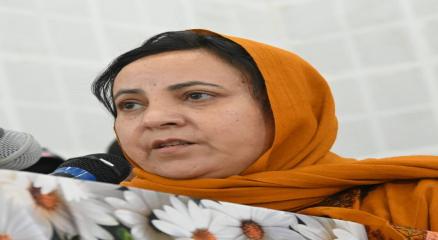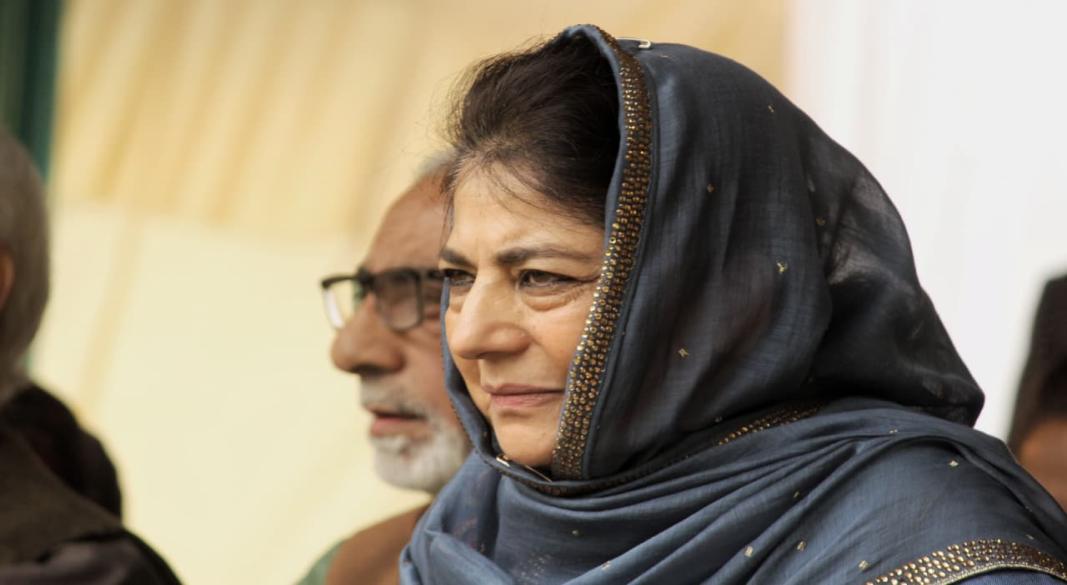
Srinagar, Jan 13: The former chief minister of Jammu & Kashmir and Peoples Democratic Party (PDP) President Mehbooba Mufti on Tuesday said the "arbitrary terminations" in J&K have been dangerously normalised.
"This isn’t just about the employee. Behind every termination is a family pushed into darkness a form of collective punishment with entire households condemned overnight by draconian Government of India (GOI) policies that mock the rule of law & discard due process," she said.
"This normalisation of injustice must stop," her post on X reads.
Her statement was in reaction to the termination of five government employees by the J&K Lieutenant Governor (LG).
Earlier on Tuesday, the Jammu and Kashmir Lieutenant Governor Manoj Sinha ordered the dismissal of five government employees for their alleged links with proscribed militant organisations.
Officials said the action was taken after investigations and intelligence inputs established their active association with terrorist outfits, misuse of official positions and continued involvement in terror-related activities, posing a serious threat to national security.
Among those dismissed included Mohammad Yousf Kumar, a driver with the Health and Medical Education Department and a resident of Ganderbal, Farooq Ahmad Bhat, a Class-IV worker of the Forest Department from Anantnag, Tariq Ahmad Rah, a laboratory technician posted at SDH Bijbehara, Mohammad Ishfaq, a teacher from Bhaderwah in Doda district and Bashir Ahmad Mir, an Assistant Lineman in the Public Health Engineering Department from Gurez in Bandipora district.
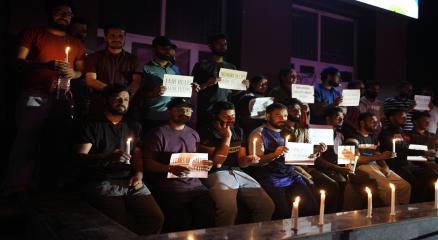
New Delhi, May 12: A massive protest organised by the National Students' Union of India (NSUI) broke out near the Shastri Bhawan on Tuesday, against the alleged paper leak in NEET-UG this year. The exam was held on May 3, following which allegations of paper leak surfaced, triggering investigations by the Rajasthan Special Operations Group (SOG) and central agencies. Earlier, the National Testing Agency (NTA) announced the cancellation of NEET-UG 2026, and said the examination will be re-conducted on dates to be notified separately. In a statement, the NTA said the decision was taken with the approval of the Government of India in the interest of maintaining transparency and preserving trust in the national examination system.
Srinagar, Feb 12: Jammu and Kashmir recorded over 15.48 lakh traffic violation cases in 2025, with authorities collecting more than Rs 34.17 crore as penalty under the Motor Vehicles Act, the Centre informed Parliament on Thursday. The information was shared in the Lok Sabha in response to a question raised by MP Janardan Singh Sigriwal. According to the official data, 15,48,525 challans were issued across the Union Territory in 2025, while the penalty amount recovered stood at Rs 34,17,36,740. The figures further show that in 2024, a total of 15,44,105 violations were registered with a penalty collection of around Rs 43.40 crore, while in 2023, 12,38,584 challans were issued and Rs 34.56 crore was collected. For the current year, till February 8, 2026, Jammu and Kashmir has recorded 1,63,531 traffic violation cases, with revenue collection of about Rs 2.11 crore. The Ministry of Road Transport and Highways stated that stricter penalties under the Motor Vehicles (Amendment) Act, 2019 are aimed at ensuring better compliance and deterrence. It also said that traffic enforcement falls under the jurisdiction of States and Union Territories. The government has issued a Standard Operating Procedure (SOP) for electronic monitoring and is promoting technology-driven enforcement through Automatic Number Plate Recognition (ANPR) cameras integrated with the VAHAN database. Awareness campaigns under the Sadak Suraksha Abhiyan are also being carried out to improve road safety.
New Delhi, Jan 25: The Dental Council of India (DCI) has directed all universities and dental colleges across the country to strictly ensure a minimum of 80 percent biometric attendance for Post Graduate students before allowing them to appear in examinations. The decision has been taken to curb absenteeism among postgraduate dental students. According to a circular issued by the Dental Council of India-a statutory body under the Ministry of Health and Family Welfare, Government of India, the decision has been taken after multiple complaints were received from dental colleges in Rajasthan, Haryana and Uttar Pradesh regarding non-attendance of PG students. "The matter was examined by the Grievance Sub-Committee of the DCI in its meeting held on November 24, 2025," the circular reads. It reads that after detailed discussion and deliberation, the committee recommended that all universities and dental colleges must ensure compliance with Regulation 18(a)(i) of the DCI Master of Dental Surgery Course Regulations, 2017, which mandates at least 80 per cent attendance. "The recommendation of the Grievance Sub-Committee has been approved by the Executive Committee of the Dental Council of India through circulation and has now been formally communicated for information and necessary action," the circular reads. As per the circular, all the universities and dental colleges have been directed to ensure minimum 80 per cent biometric attendance of all PG students before permitting them to appear in examinations. The order, issued by Deputy Secretary Dental Council of India Mukesh Kumar, is expected to be implemented with immediate effect across the country.
Srinagar, Jan 8: Contractual faculty members working in government degree colleges of Jammu and Kashmir Higher Education Department (HED) have expressed strong resentment over what they term as a glaring disparity in salaries, demanding revision of their pay in line with University Grants Commission (UGC) norms and regularisation of their services. The faculty, many of whom hold PhDs and are qualified through NET, SET and JRF, said they have been denied UGC-recommended pay scales despite discharging academic responsibilities equivalent to their regular counterparts. “Hundreds of highly qualified scholars have been pushed into silent suffering. For years, we have been assured that our pay revision is under consideration, but nothing has materialised so far,” said Dr Ishfaq Gowhar, a contractual faculty member. Earlier, Director Colleges J&K had acknowledged the legitimacy of the faculty’s demand, stating that while the issue was genuine, its implementation involved significant financial implications due to the large number of contractual appointments. “We are aware that they deserve salary enhancement, but the number of contractual faculty is huge and it has financial implications,” he earlier said. Dr Gowhar pointed out that contractual lecturers, who form the backbone of the higher education system, continue to work on a fixed monthly honorarium of Rs 28,000, which has remained unchanged for nearly a decade. “The irony is that a Class IV employee with a Class 10 qualification draws a salary exceeding Rs 50,000, while doctorate-holding teachers engaged in teaching, mentoring and academic research are paid a fraction of that,” he said. He added that institutions such as SKUAST-K, University of Kashmir and Islamic University of Science and Technology (IUST) have implemented revised UGC pay scales, but the Higher Education Department has failed to extend similar treatment to its contractual faculty. Dr Gowhar said the demand for “equal work, equal pay” gets prominently featured in election campaigns, raising hopes among contractual teachers. “Promises were made and slogans echoed during elections, but once the process ended, our voices were reduced to silence. Even meeting officials now feels impossible,” he said. He said contractual faculty were not seeking privileges but dignity, fairness and recognition for their service. The faculty appealed to the Jammu and Kashmir Lieutenant Governor Manoj Sinha, Chief Minister Omar Abdullah and the Education Minister to intervene and take concrete steps towards addressing their long-pending demands. “This issue is not merely about salaries. It is about survival, justice and dignity in the classrooms of Jammu and Kashmir,” he said.
Srinagar, March 6: Around 17 candidates from Jammu and Kashmir have qualified the Civil Services Examination (CSE)-2025, the result for which was declared by the Union Public Service Commission (UPSC) on Friday. The commission recommended a total of 958 candidates for appointment to the Indian Administrative Service (IAS), Indian Foreign Service (IFS), Indian Police Service (IPS) and various central services. Anuj Agnihotri, an MBBS graduate, has topped the civil services examination 2025, while Rajeshwari Suve M and Akansh Dhull have got the second and third ranks respectively. According to the official list released by the UPSC the 17 candidates from J&K who have figured in the final merit list include Suvan Sharma (Rank 148), Sugandha Gupta (207), Towseef Ganie (Rank 254), Ritika (Rank 456), Sooyash Shivam (Rank 572), Muneeb Parrah (Rank 581), Ghulam Din (Rank 683), Dwarka Gaadhi (Rank 721), Akash (Rank 747), Koh E Safa (Rank 763), Yasaar (Rank 811), Abhishek (Rank 820), Pankaj (Rank 856), Mohammad Ajaz (Rank 869), Azhar (Rank 886), Sarfraz (Rank 936), and Irfan (Rank 957). The results were declared after conducting the written examination in August 2025 followed by the personality tests (interviews) conducted between December 2025 and February 2026. As per the result notification issue by the UPSC, a total of 958 candidates have been recommended for appointment against 1087 vacancies reported by the government for the examination cycle. These include 180 vacancies in the IAS, 55 in the IFS, 150 in the IPS, 507 in Central Services Group A and 195 in Group B services. Of the total recommended candidates, 317 are from the general category, 104 from the economically weaker sections, 306 from other backward classes, 158 from scheduled castes and 73 from scheduled tribes. A consolidated reserve list of 258 candidates has also been published in accordance with the rules. The claims of recommended candidates regarding reservation categories will be subject to verification by the concerned authorities. The UPSC has stated that the candidature of 348 recommended candidates has been kept provisional, while the result of the two candidates has been kept withheld. The CSE is conducted annually in three stages- preliminary, Mains and interview by the UPSC to select officers of the Indian Administrative Service (IAS), Indian Foreign Service (IFS) and Indian Police Service (IPS) among others. The civil services (preliminary) examination 2025 was conducted on May 25 of 2025. A total of 937876 candidates applied for this examination, out of which 5,76,793 actually appeared in the test. A total of 14,161 candidates qualified for appearance in the written (Main) examination which was held in August, 2025. Of these, 2736 candidates had qualified for the personality test (interview) of the examination. Prime Minister Narendra Modi congratulated the candidates who qualified the UPSC exam. "Congratulations to all those who have successfully cleared the Civil Services Examination, 2025. Their dedication, perseverance and hard work have led to this significant milestone. Wishing them the very best as they embark on a journey of serving the nation and fulfilling the aspirations of the people," PM Modi wrote on his official X handle. "To those who may not have secured the desired outcome in the Civil Services Examination, I understand that such moments can be difficult. However, this is only one step in a larger journey. Many opportunities lie ahead, both in future examinations and in the many avenues through which you can contribute to our nation. My best wishes for the road ahead," his post on X reads. UPSC chairman Ajay Kumar announced the declaration of the result and congratulated the candidates who qualified the exam. "Congrats to all successful candidates as you begin a career of service to the nation. For those who did not make it-the learning from this journey will guide you in the paths ahead," UPSC Chairman wrote in a post on X. Among the 17 candidates from J&K who qualified UPSC exam inlcude a visually impaired candidate Irfan Ahmad Lone, a resident of Manzpora in the Naidkhai area of Bandipora.


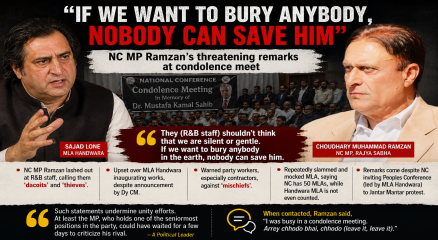
Srinagar, July 17: In shocking remarks, National Conference Member of Parliament Choudhary Muhammad Ramzan on Thursday said if they want to bury anybody in the earth, "nobody can save him.” The NC MP made these remarks during a condolence meeting called by the National Conference in Handwara over the death of party leader Dr. Mustafa Kamal. “They (R&B staff) shouldn’t think that we are silent or gentle. If we want to bury anybody in the earth, nobody can save him,” Ramzan said during the meeting, where a banner on the wall identified it as a condolence gathering. Ramzan made the controversial statement on the same day Chief Minister Omar Abdullah cautioned against mixing politics with grief. “If you want to do politics, then don’t come to offer condolences. You come to our home to express sympathy and then step outside to make political statements. Grief and politics should not be mixed,” the CM said, adding that he would not discuss politics during the mourning period. At the Handwara meeting, according to a viral video shared on social media, Ramzan lashed out at staff of the Roads & Buildings Department, calling them “dacoits” and “thieves”. “Some officers here are not right. The Executive Engineer is also among them, and we are keeping a strict vigil over them. Until today, we have forgiven him only because of his father. I know why the Executive Engineer is engaging in mischief. They are thieves, they are dacoits…” he said. Ramzan also appeared upset over the inauguration of macadamisation works by MLA Handwara, remarking: “The MLA did not remember that he had to do anything over the past two years, during which he did nothing. The works were announced by the Deputy Chief Minister, but the MLA has come to inaugurate the macadamisation of Handwara bus stand. It was the Deputy Chief Minister who made the announcement and released the money.” The National Conference‑led government has made it mandatory for officers to invite concerned MLAs to all official functions. Ramzan also warned his party workers to refrain from indulging in mischief. “I want to remind my workers, particularly contractors, that mischiefs made by you with the party will not be tolerated. You should choose only one path,” he said. In his speech, the NC MP repeatedly slammed and mocked the MLA from Handwara, saying the NC has 50 MLAs while the Handwara MLA is not even counted. Ramzan made the remarks at a time when the Peoples Conference headed by MLA Handwara has been invited by the National Conference to participate in the Jantar Mantar protests. Ramzan’s statement, made at the time of the Jantar Mantar protest against a party that had been invited, has raised eyebrows in political circles. “Such statements undermine unity efforts. At least the MP, who holds one of the seniormost positions in the party, could have waited for a few days to criticize his rival. Why cannot our political leaders shun differences for a few days for the larger cause?” asked a political leader. When contacted, Ramzan said that he was busy in a condolence meeting. “Arrey chhodo bhai, chhodo (leave it, leave it),” he remarked when asked about his comments. (KNO)
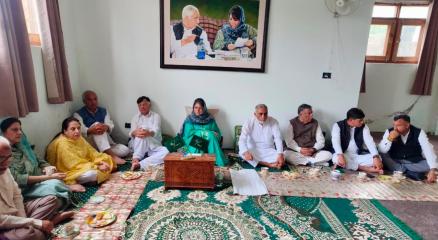
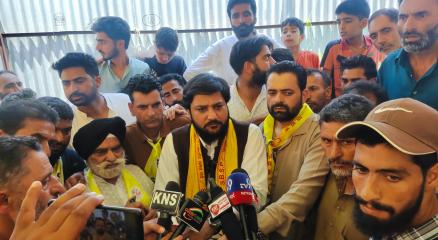
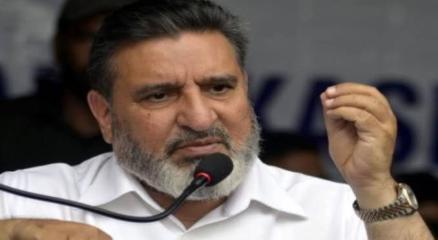
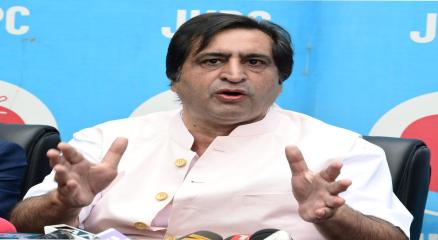
Srinagar, June 28: J&K Peoples Conference President and MLA Handwara, Sajad Lone Sunday launched a fierce political offensive against the National Conference government over what he describes as a deeply compromised outsourcing regime in Jammu and Kashmir, promising explosive disclosures within a week. In a statement directed squarely at the ruling party, Lone declared, "To my friends in NC please be ready to answer a range of questions on Outsourcing. As promised within a week we will put every fact about outsourcing in the public domain." While stopping short of holding NC responsible for originating the outsourcing policy, Lone made the party's complicity unmistakably clear. "Agreed NC didn't start it. We knew that from Day 1. But you didn't stop it either. You went along with it. And in fact encouraged it," he stated, leaving no room for the ruling party to distance itself from the consequences of a policy it inherited but chose to sustain and expand. Lone then made his most serious allegation, one that goes beyond policy failure into the territory of outright wrongdoing. "Outsourcing is prone to corrupt collusion. And that corrupt collusion I can see very clearly," he said, signalling that his upcoming disclosures are backed by concrete information rather than political conjecture. Adding a documented dimension to his offensive, Lone revealed that he had formally raised a Starred Question before the General Administration Department during the last Assembly session, demanding full disclosure on the government's outsourcing activities. The question, a photograph of which he shared publicly, sought information on the total number of outsourced jobs across the government sector, the names and addresses of every outsourcing company currently engaged by the government, the total payments made to these companies across all departments, whether standardised salary guidelines exist for outsourced workers, and a complete department-wise breakdown of outsourced positions. The government responded only partially, and Lone pointed out that it chose to stay completely silent on the two most revealing and consequential parts of his question. It failed to respond to part (f), which asked, "What is the government's objective in outsourcing jobs? Does the government see outsourcing as means to reduce costs or as means to improve efficiency?" It equally avoided part (g), which asked, "Will government as a policy encourage or discourage outsourcing of government jobs?" Lone underlined the gravity of this silence, saying, "That remains unanswered and the devil is in the details," making clear that a government unwilling to state its own policy objectives on outsourcing has questions far bigger than administrative gaps to answer.
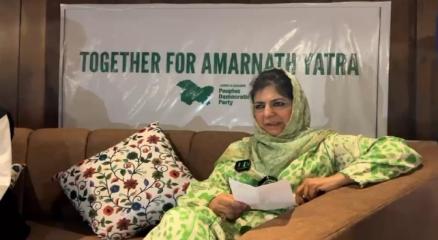
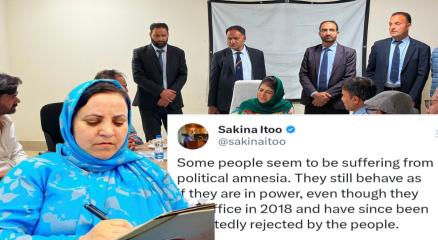
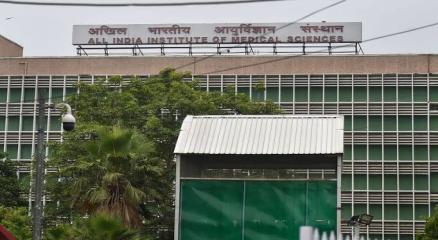
Srinagar June 5: Minister for education Sakina Itoo on Friday took a dig at former J&K chief minister Mehbooba Mufti saying that "they still behave as if they are in power." In a post on X, Sakina Itoo mocked at Peoples Democratic Party (PDP) chief Mehbooba Mufti saying "Some people seem to be suffering from political amnesia." "They still behave as if they are in powereven though they lost office in 2018 and have since been repeatedly rejected by the people," Itoo in her post on X said. The remarks came hours after Mehbooba Mufti along with MLA Tral Rafiq Ahmad Maik and MLA Pulwama Waheed Ur Rehman Parra visited AIIMS Awantipora to "understand the progress being made on the project and engage with the concerned agencies on the ground." She convened a meeting with the officers and reiterated her commitment to supporting every effort aimed at the early completion of this important healthcare institution. Later in her post on X, Mehbooba Mufti said "Mufti sahab envisioned & laid the foundation for AIIMS Awantipora in 2015 & today I’m delighted to see his dream come to fruition." "Much progress has been made on this crucial institution - a project initiated by the PDP over a decade ago. AIIMS Awantipora has the potential to emerge as one of the leading centres of healthcare, medical education and research in J&K," the post reads. "Request Union Health Minister @JPNadda ji to kindly expedite completion of this vital institution so that quality healthcare services can reach the people of J&K at the earliest," it reads. Meanwhile, Sakina Itoo said the elected government today wass led Chief Minister Omar Abdullah. "Yet one wonders in what capacity former rulers are conducting reviews of the AIIMS Awantipora project," Sakina Itoo said. "More importantly, who is signalling them to undertake such exercises? Which power centre in Delhi is directing these actions?" the post reads. She said that it was ironic that those because of whom the AIIMS project moved at a painfully slow pace are now trying to claim ownership of its progress. "The fact is that the project is moving towards completion because of the focused efforts, monitoring and commitment of the present government under the leadership of CM Omar Abdullah," Sakina Itoo said. She said the people of Jammu & Kashmir are wise enough to distinguish between those who delayed development and those who are ensuring its delivery.