By Dr. Aftab Jan
In the 21st century, the internet has become an inseparable part of our lives. From education to entertainment, it has revolutionized the way we live, work, and interact. However, as the digital age progresses, a growing concern has emerged: the impact of early internet exposure on children s brain development. This article delves into the hidden dangers of excessive screen time, the role of parents and educators in mitigating these risks, and the collective responsibility of society to ensure a healthier future for the next generation.
The Science Behind Early Internet Exposure and Brain Development
The human brain undergoes its most rapid and critical development during the first five years of life. During this period, neural connections are formed at an astonishing rate, shaping cognitive, emotional, and social abilities. However, excessive exposure to screens and digital content during these formative years can disrupt this delicate process.
Cognitive Development
Research shows that prolonged screen time can impair cognitive functions such as memory, problem-solving, and critical thinking. The fast-paced, overstimulating nature of digital content overwhelms young brains, making it difficult for children to process information effectively. This can lead to poor academic performance and a reduced ability to engage in deep, focused learning.
Attention Span and Focus
The constant bombardment of flashy visuals, rapid scene changes, and instant rewards from digital content conditions children s brains to seek constant stimulation. This reduces their ability to focus on tasks that require sustained attention, such as reading or solving complex problems. Over time, this can lead to attention deficits and restlessness.
Emotional and Social Development
Excessive screen time often replaces face-to-face interactions, which are crucial for developing emotional intelligence and social skills. Children who spend too much time online may struggle to interpret non-verbal cues, empathize with others, or build meaningful relationships. This can lead to feelings of isolation, anxiety, and depression.
Sleep and Physical Health
The blue light emitted by screens interferes with the production of melatonin, the hormone responsible for regulating sleep. This can lead to sleep disturbances, which are linked to a host of issues, including obesity, weakened immunity, and poor mental health. Additionally, sedentary behavior associated with excessive screen time contributes to physical health problems such as obesity and poor posture.
Language Development
Language skills are best developed through real-life interactions, where children can observe facial expressions, hear tonal variations, and engage in back-and-forth conversations. Excessive screen time limits these opportunities, potentially delaying language acquisition and communication skills.
Renowned doctors, scientists, and global health organizations have voiced their concerns about the impact of early internet exposure on children s brain development.
Dr. Jenny Radesky a developmental behavioral pediatrician at the University of Michigan, emphasizes the importance of face-to-face interactions for emotional and social development. She notes that children who spend too much time on screens may miss out on critical opportunities to develop empathy and communication skills.
Dr. Aric Sigman, a psychologist and author, highlights the link between excessive screen time and mental health issues. His research shows that children who spend more than two hours a day on screens are at a higher risk of developing anxiety, depression, and attention disorders.
Dr. Michael Rich, director of the Center on Media and Child Health at Harvard University, advocates for a balanced approach to technology use. He stresses that while the internet can be a valuable tool for learning, it should not replace real-life experiences and interactions.
Scientists Warnings
Dr. Manfred Spitzer, a German neuroscientist, argues that "digital dementia" is a growing concern. He warns that young children exposed to too much screen time may develop cognitive deficits similar to those found in dementia patients.
Dr. Susan Greenfield, a British neuroscientist, cautions that excessive screen exposure alters neural pathways, making children less capable of deep thinking, problem-solving, and emotional regulation.
Global Health Organizations Recommendations
The World Health Organization (WHO) recommends that children under two years old should have zero screen time, and children aged 2 5 should be limited to one hour per day.
The American Academy of Pediatrics (AAP) suggests that parents should co-view content with children and encourage more offline activities.
UNICEF highlights that while digital learning has benefits, excessive screen time without parental guidance can hinder social and emotional development.
The Role of Parents: A Call for Responsible Digital Parenting
Parents are the first and most influential role models in a child s life. In the digital age, their role extends beyond traditional parenting to include guiding their children s relationship with technology. Here s how parents can take charge:
Set Clear Boundaries
Establish rules for screen time that are age-appropriate and consistent. For example, the American Academy of Pediatrics recommends no screen time for children under 18 months, except for video chatting, and no more than one hour per day for children aged 2 to 5.
Encourage Real-World Activities
Prioritize activities that promote physical, cognitive, and emotional growth, such as outdoor play, reading, arts and crafts, and family bonding. These activities not only reduce screen dependency but also foster creativity, problem-solving, and social skills.
Monitor Online Content
Not all screen time is created equal. Parents should ensure that their children are exposed to educational, age-appropriate content while shielding them from harmful or inappropriate material. Tools like parental controls and content filters can be helpful in this regard.
Children often mimic their parents behavior. By practicing mindful technology use such as putting away phones during meals or family time parents can set a positive example and reinforce the importance of real-world connections.
We should encourage children to share their online experiences and concerns. By maintaining an open dialogue, parents can better understand their children s digital habits and guide them toward responsible internet use.
The Role of Teachers, Especially Physical Education Teachers
Schools and educators play a critical role in shaping children s relationship with technology. Physical education (PE) teachers, in particular, are uniquely positioned to counteract the negative effects of excessive screen time.
Regular physical activity is essential for brain development, emotional well-being, and overall health. PE teachers can design engaging programs that encourage students to participate in sports, exercise, and outdoor play. Activities like team sports, yoga, and dance not only improve physical fitness but also teach valuable life skills such as teamwork, discipline, and resilience.
Schools should adopt active learning methods that reduce reliance on screens and encourage hands-on, interactive experiences. For example, science experiments, art projects, and group discussions can make learning more engaging and effective.
Teachers should educate students about the importance of balancing technology with physical activity. This includes discussing the risks of internet addiction, the benefits of a healthy lifestyle, and strategies for managing screen time.
Schools can foster a culture of wellness by organizing events like sports days, fitness challenges, and outdoor excursions. These initiatives not only promote physical activity but also strengthen social bonds and school spirit.
A Collective Responsibility: Society s Role in Safeguarding Young Minds
The issue of early internet exposure is not just a concern for parents and educators it is a societal challenge that requires collective action. Governments, tech companies, and communities must work together to create a safer, healthier digital environment for children.
Governments should implement regulations that protect children from harmful online content and promote digital literacy. For example, age restrictions, content warnings, and mandatory educational programs on responsible internet use can make a significant difference.
Tech companies have a responsibility to design products that prioritize user well-being. Features like screen time trackers, parental controls, and content filters can help parents manage their children s digital habits more effectively.
Local communities can organize workshops, seminars, and awareness campaigns to educate parents and children about the risks of excessive screen time and the benefits of a balanced lifestyle.
A Balanced Approach for a Brighter Future
The internet is a powerful tool that has the potential to enrich our lives in countless ways. However, it should never replace the irreplaceable value of real-life experiences, human connections, and physical activity. By adopting a balanced approach that combines the benefits of technology with traditional childhood experiences, we can raise intelligent, emotionally stable, and socially competent individuals.
The responsibility to safeguard young minds lies with all of us parents, educators, policymakers, and society as a whole. Let us take the necessary steps today to ensure a healthier, happier future for the next generation.
As a researcher and educator, I firmly believe that the overuse of the internet and digital devices is one of the most pressing challenges facing our children today. The evidence is clear: excessive screen time harms brain development, emotional well-being, and physical health. However, the solution lies not in demonizing technology but in finding a balanced approach.
Parents, educators, and policymakers must work together to create an environment where technology is used as a tool for learning and growth, not as a substitute for real-life experiences. By setting boundaries, encouraging physical activity, and fostering open communication, we can help our children navigate the digital world safely and responsibly.
Let us take this message to heart and act now. The future of our children depends on it.
It is a reminder that the future of our children is in our hands. By understanding the risks of early internet exposure and taking proactive steps to mitigate them, we can create a world where technology enhances, rather than hinders, the development of young minds.
Let us come together to praise and share this message, ensuring that it reaches every corner of the globe. Together, we can build a brighter, healthier future for generations to come.
New Delhi, May 12: A massive protest organised by the National Students' Union of India (NSUI) broke out near the Shastri Bhawan on Tuesday, against the alleged paper leak in NEET-UG this year. The exam was held on May 3, following which allegations of paper leak surfaced, triggering investigations by the Rajasthan Special Operations Group (SOG) and central agencies. Earlier, the National Testing Agency (NTA) announced the cancellation of NEET-UG 2026, and said the examination will be re-conducted on dates to be notified separately. In a statement, the NTA said the decision was taken with the approval of the Government of India in the interest of maintaining transparency and preserving trust in the national examination system.
Srinagar, Feb 12: Jammu and Kashmir recorded over 15.48 lakh traffic violation cases in 2025, with authorities collecting more than Rs 34.17 crore as penalty under the Motor Vehicles Act, the Centre informed Parliament on Thursday. The information was shared in the Lok Sabha in response to a question raised by MP Janardan Singh Sigriwal. According to the official data, 15,48,525 challans were issued across the Union Territory in 2025, while the penalty amount recovered stood at Rs 34,17,36,740. The figures further show that in 2024, a total of 15,44,105 violations were registered with a penalty collection of around Rs 43.40 crore, while in 2023, 12,38,584 challans were issued and Rs 34.56 crore was collected. For the current year, till February 8, 2026, Jammu and Kashmir has recorded 1,63,531 traffic violation cases, with revenue collection of about Rs 2.11 crore. The Ministry of Road Transport and Highways stated that stricter penalties under the Motor Vehicles (Amendment) Act, 2019 are aimed at ensuring better compliance and deterrence. It also said that traffic enforcement falls under the jurisdiction of States and Union Territories. The government has issued a Standard Operating Procedure (SOP) for electronic monitoring and is promoting technology-driven enforcement through Automatic Number Plate Recognition (ANPR) cameras integrated with the VAHAN database. Awareness campaigns under the Sadak Suraksha Abhiyan are also being carried out to improve road safety.
New Delhi, Jan 25: The Dental Council of India (DCI) has directed all universities and dental colleges across the country to strictly ensure a minimum of 80 percent biometric attendance for Post Graduate students before allowing them to appear in examinations. The decision has been taken to curb absenteeism among postgraduate dental students. According to a circular issued by the Dental Council of India-a statutory body under the Ministry of Health and Family Welfare, Government of India, the decision has been taken after multiple complaints were received from dental colleges in Rajasthan, Haryana and Uttar Pradesh regarding non-attendance of PG students. "The matter was examined by the Grievance Sub-Committee of the DCI in its meeting held on November 24, 2025," the circular reads. It reads that after detailed discussion and deliberation, the committee recommended that all universities and dental colleges must ensure compliance with Regulation 18(a)(i) of the DCI Master of Dental Surgery Course Regulations, 2017, which mandates at least 80 per cent attendance. "The recommendation of the Grievance Sub-Committee has been approved by the Executive Committee of the Dental Council of India through circulation and has now been formally communicated for information and necessary action," the circular reads. As per the circular, all the universities and dental colleges have been directed to ensure minimum 80 per cent biometric attendance of all PG students before permitting them to appear in examinations. The order, issued by Deputy Secretary Dental Council of India Mukesh Kumar, is expected to be implemented with immediate effect across the country.
Srinagar, Jan 8: Contractual faculty members working in government degree colleges of Jammu and Kashmir Higher Education Department (HED) have expressed strong resentment over what they term as a glaring disparity in salaries, demanding revision of their pay in line with University Grants Commission (UGC) norms and regularisation of their services. The faculty, many of whom hold PhDs and are qualified through NET, SET and JRF, said they have been denied UGC-recommended pay scales despite discharging academic responsibilities equivalent to their regular counterparts. “Hundreds of highly qualified scholars have been pushed into silent suffering. For years, we have been assured that our pay revision is under consideration, but nothing has materialised so far,” said Dr Ishfaq Gowhar, a contractual faculty member. Earlier, Director Colleges J&K had acknowledged the legitimacy of the faculty’s demand, stating that while the issue was genuine, its implementation involved significant financial implications due to the large number of contractual appointments. “We are aware that they deserve salary enhancement, but the number of contractual faculty is huge and it has financial implications,” he earlier said. Dr Gowhar pointed out that contractual lecturers, who form the backbone of the higher education system, continue to work on a fixed monthly honorarium of Rs 28,000, which has remained unchanged for nearly a decade. “The irony is that a Class IV employee with a Class 10 qualification draws a salary exceeding Rs 50,000, while doctorate-holding teachers engaged in teaching, mentoring and academic research are paid a fraction of that,” he said. He added that institutions such as SKUAST-K, University of Kashmir and Islamic University of Science and Technology (IUST) have implemented revised UGC pay scales, but the Higher Education Department has failed to extend similar treatment to its contractual faculty. Dr Gowhar said the demand for “equal work, equal pay” gets prominently featured in election campaigns, raising hopes among contractual teachers. “Promises were made and slogans echoed during elections, but once the process ended, our voices were reduced to silence. Even meeting officials now feels impossible,” he said. He said contractual faculty were not seeking privileges but dignity, fairness and recognition for their service. The faculty appealed to the Jammu and Kashmir Lieutenant Governor Manoj Sinha, Chief Minister Omar Abdullah and the Education Minister to intervene and take concrete steps towards addressing their long-pending demands. “This issue is not merely about salaries. It is about survival, justice and dignity in the classrooms of Jammu and Kashmir,” he said.
Srinagar, March 6: Around 17 candidates from Jammu and Kashmir have qualified the Civil Services Examination (CSE)-2025, the result for which was declared by the Union Public Service Commission (UPSC) on Friday. The commission recommended a total of 958 candidates for appointment to the Indian Administrative Service (IAS), Indian Foreign Service (IFS), Indian Police Service (IPS) and various central services. Anuj Agnihotri, an MBBS graduate, has topped the civil services examination 2025, while Rajeshwari Suve M and Akansh Dhull have got the second and third ranks respectively. According to the official list released by the UPSC the 17 candidates from J&K who have figured in the final merit list include Suvan Sharma (Rank 148), Sugandha Gupta (207), Towseef Ganie (Rank 254), Ritika (Rank 456), Sooyash Shivam (Rank 572), Muneeb Parrah (Rank 581), Ghulam Din (Rank 683), Dwarka Gaadhi (Rank 721), Akash (Rank 747), Koh E Safa (Rank 763), Yasaar (Rank 811), Abhishek (Rank 820), Pankaj (Rank 856), Mohammad Ajaz (Rank 869), Azhar (Rank 886), Sarfraz (Rank 936), and Irfan (Rank 957). The results were declared after conducting the written examination in August 2025 followed by the personality tests (interviews) conducted between December 2025 and February 2026. As per the result notification issue by the UPSC, a total of 958 candidates have been recommended for appointment against 1087 vacancies reported by the government for the examination cycle. These include 180 vacancies in the IAS, 55 in the IFS, 150 in the IPS, 507 in Central Services Group A and 195 in Group B services. Of the total recommended candidates, 317 are from the general category, 104 from the economically weaker sections, 306 from other backward classes, 158 from scheduled castes and 73 from scheduled tribes. A consolidated reserve list of 258 candidates has also been published in accordance with the rules. The claims of recommended candidates regarding reservation categories will be subject to verification by the concerned authorities. The UPSC has stated that the candidature of 348 recommended candidates has been kept provisional, while the result of the two candidates has been kept withheld. The CSE is conducted annually in three stages- preliminary, Mains and interview by the UPSC to select officers of the Indian Administrative Service (IAS), Indian Foreign Service (IFS) and Indian Police Service (IPS) among others. The civil services (preliminary) examination 2025 was conducted on May 25 of 2025. A total of 937876 candidates applied for this examination, out of which 5,76,793 actually appeared in the test. A total of 14,161 candidates qualified for appearance in the written (Main) examination which was held in August, 2025. Of these, 2736 candidates had qualified for the personality test (interview) of the examination. Prime Minister Narendra Modi congratulated the candidates who qualified the UPSC exam. "Congratulations to all those who have successfully cleared the Civil Services Examination, 2025. Their dedication, perseverance and hard work have led to this significant milestone. Wishing them the very best as they embark on a journey of serving the nation and fulfilling the aspirations of the people," PM Modi wrote on his official X handle. "To those who may not have secured the desired outcome in the Civil Services Examination, I understand that such moments can be difficult. However, this is only one step in a larger journey. Many opportunities lie ahead, both in future examinations and in the many avenues through which you can contribute to our nation. My best wishes for the road ahead," his post on X reads. UPSC chairman Ajay Kumar announced the declaration of the result and congratulated the candidates who qualified the exam. "Congrats to all successful candidates as you begin a career of service to the nation. For those who did not make it-the learning from this journey will guide you in the paths ahead," UPSC Chairman wrote in a post on X. Among the 17 candidates from J&K who qualified UPSC exam inlcude a visually impaired candidate Irfan Ahmad Lone, a resident of Manzpora in the Naidkhai area of Bandipora.


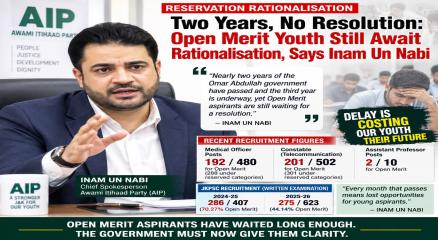
Bhat Hilal AhmadA policy framework backed by transparent Matrix only can withstand judicial interventions while maintaining social harmony.G D sharma report should be released for public scrutiny.True interpretation of rule of prudence be made.A revisit of Rule 17 is must for ensuring appropriate seat balance.Rationalisation of reservations is directly proportional to meritocracy and ensuring a just society.Jammu and Kashmir with a young demographic profile has one of the highest proportions of general category population in the country estimated arround 60 to 70 percent but lowest open merit quota which roughly stands between 30 to 40 percent.States across the country with comparatively lesser general category population continue to maintain 50 percent reservation for open merit share.A shift from policy decisions and demographic legal principles has resulted in a structural framework which significantly differs from the national norms.It is when courts across India have always emphasised that reservation policies must rest on contemporary quantifiable evidence.Though government maintains that the present reservation framework follows Reservation Act 2004 and its rules according to 2005 that should be read with new notification SO-176 of March 2024.But lot of reservations and concerns have emerged about the proportionality , transparancy and opportunity of merit where certain newly introduced reservations are found drawing benifit patterns on the basis of regions and geography.In its verdict on November 16 ( 1992 ) Supreme Court in Indra Sawhney verses union of India case held that reservations should not ordinary exceed beyond 50 percent except in the exceptional and extraordinary circumstances.However in 2022 in Janhit Abhiyan case court while upholding the ten percent reservation for economically weaker sections observed that fifty percent ceiling is not a compulsory limit but a rule of prudence.Taking a flexible and wider interpretation of this directive parliament in February 2024 ammended 2005 reservation rules and reservation percentages were altered by introducing EWS at 10 percent and increasing it to 20 percent for ST , 28 percent for OBC while RBA saw reductions.This was largely based on publicly available socio economic survey and not on an updated sensus or data.Consequently LG administration announced new quotas like Paharis , paddari , koli , Gadda brahmin and other casts.Social welfare department quickly followed by distributing new proportions which led to decrease of open merit quota.As per new policy 61% seats of government jobs and professional admissions are reserved and only 39 are for open merit share.This clearly shows that open merit candidates are slowly pushed out of the system though government stands by its constitutional interpretation by saying that it goes well with constitutional guidelines and court rules.In just last two years 8.21 lack reservation certificates were issued in J & K in which 6.78 lakh ( 82% ) were issued in jammu and only 1.45 lakh certificates were issued in kashmir.For scheduled cast only more than 69000 certificates were issued in jammu while it remained only 474 for Kashmir which is just 0.64 percent.Accordingly for ST 5.25 lakh certificates were issued for jammu while it remained 76656 for Kashmir.Out of 21386 , 18963 EWS certificates were issued for jammu and only 2431 certificates were issued for kashmir division.Similarly for ALC jammu is ahead with 85% and it is for RBA only where kashmir is ahead with 31804 certificates while jammu has 15550 certificates.While looking at the shares in the second line bureaucracy JKAS , JKAS ( accounts ) and JKPS the numbers itself tell the story of last three years.In 2023 only 39 selections were made for open merit in JKAS as compared to 50 selections made for reserved categories like Sc , ST and Ews.In 2024 open merit selections were 50 while 43 selections were made for reserved categories.In 2025 , 24 selections were made for open merit while the numbers remained almost equal in all the three civil services.In JK Accounts service 29 , 27 and 15 selections were made from open merit in 2023 , 2024 and 2025 while it remained 26 , 25 and 09 for reserved categories in 2023 , 2024 and 2025 respectively.Though the numbers does not go against any legal quota but it questions fairness and representation.In March 2020 J&K government constituted GD Sharma comission to examine backwardness and rationalise reservations for different categories and the report is yet to come in the public domain.The current reservation structural framework stands at ten percent for EWS, ten percent for RBA , 8 percent for SC , 8 percent of OBC , 10 percent for ST-1 10 percent for ST-2 and 4 percent for ALC/IB which makes a mighty total of 60 percent for the reserved categories.The rest 40 percent are shared by general category and horizontal reservations.An element of the centre of the debate is Rule -17 which allows reserved categories to initially take open merit seats and letter shift back to their respective categories.When this happens the seat already occupied does not automatically return to the open merit pool thereby further reducing the share available to open category competition.Not only so the horizontal reservations which cover women , ex servicemen , sports , and persons with special abilities appear to be applied largely on open merit quota rather than proportionally across all categories.This again makes general category to bear the brunt of disproportionate share of adjustments which was otherwise expected to be distributed evenly.In December 2024 a cabinet sub committee was constituted to consult all stakeholders for reviewing and revisiting the existing policy to reshape a much acceptable reservation policy.The report was approved by the council of ministers in the cabinet and sent for its final approval to honourable LG.If sources are to be believed the cabinet has reportedly slashed reservation of EWS by 7 percent and RBA by 3 percent while managing a much needed ten percent quota for general category subjected to approval from the LG administration.If the same trend follows in filling the vacancies it will be very hard for the merit to survive and that will lead to an absolute brain drain.Moreover , the absence of an updated data and matrix question the basis of the changes and modification.The question is not about reservation but the way of its dis-proportionate distribution.G D sharma lead committee report should be made public for its scrutiny.It is high time to go for a data driven neutral and transparent re-examination which is based on updated statistics.Recalibration rather than an overhaul of the structural framework will do the job.Open merit share must reflect demographic proportion.Distribution of horizontal reservations should be made across all categories rather than concentrating them fully on general category.The much controversial Rule 17 should be revisited and probably done away with to ensure a proper seat balance.This will lead to a structural framework which will be purely based on fairness and transparency and grounded on the principles of proportionality and opportunity thus maintaining a fine balance between merit and constitutional limits.That will give rise to an equitable and a rationalised reservation system which will be effective and acceptable to all sections of the society.Bhat Hilal Ahmad ( Biotech ) is a writer who comes up with a comprehensive analysis on Educational, Social and Political developments.



Mohammad NoumaanA parent always wants their child to rise, to do something great in life; something which can earn them a good reputation. There is a time in everyone's life that is Teenage, in the phase of life a child starts developing different habits and positive thoughts, teens go through many changes over this period.During this time a child longs for parental trust and support, but sadly this is where things go wrong, parents get lost in thoughts like "What if my child got involved in something bad" or "What if my child makes mistakes".And to stop the teen from exploring the evils of the society which are often tempting, because teenage is the time when curiosity among youth is at its peak. So to tackle this a parent has two options: first it can doubt the child unnecessarily, killing the young and ambitious mind, or most of the parents overthink about the child, listen to what opinions do their relatives have regarding their own child.Moreover, parents can talk to the child, show trust upon him/her or check what the child is actually involved in. Teenagers need trust, not suspicion; guidance, not restrictions. A little support can turn curiosity into creativity and doubt into confidence. Meanwhile, during teenage a teen starts to explore hobbies and passions, teens starts doing things which excite them, some get involved into bad company, bad habits or maybe the social evils, disrupting their life and reputation, but many others start to discover what truly excites them, some like playing cricket or any other sport, some take part in gaming, singing or something else.But over the changing times some children are drawn towards working online, or learning skills which they actually enjoy, like some of the new-generation teens like doing cinematography, some like doing photography at a very young age, some like doing freelancing, not to make money but to get exposure, to learn something new and more practical, some like creating content, not to get fame or money but to try something out of the box,but there is the problem. This is the point where most of the parents fail, suppose when their teen says "I am going to play cricket!" Parents often reply positively, when the teen says "I am playing a video game" the parent allows without any second though, but when a child asks for a phone to learn cinematography, parents hesitates and think "what if this phone derailed my child from his studies", but they really forget that what if this phone was the gateway to their child's passion, what if that's the child's actual path! When a teen says "I am working for a client online", instead of doubting or over thinking, parents can simply ask the child; "Son, can you show me what did you made for the client?" "Can you make a cinematic video of our kitchen?"By showing this simple interest a child gets deeply motivated, it shows the teen that their dreams really matter, which results in making them more ambitious and confident.A parent should always support a child, it should always listen to the child especially during the teenage years, and they should always try to understand what their child is aiming for. If you see a child in the society doing something wrong, don't imprint the same on your child. Instead educate them about the pros and cons of every path and keep guiding them with love, trust and clarity. Why stick to traditional career paths just because that s what has always been done? The world is changing and so should our thinking. Every child is built differently, if you give the same task to 10 different children you will get 10 different outcomes, because every child learns, understands, and acts in their own unique way.So a parent must let their child learn and understand things at their own pace. You cannot force a child to learn something that they don t like.Today's parents often give wings to their children to fly but they forget to give them an open sky! A child can be a cinematographer, a cricketer, an entrepreneur or whatever they are passionate about. We as a society must learn to accept and celebrate such talents. Have we ever thought for how long are we going to stick to the traditional way of choosing professions, like completing school, getting a degree, the degree which is often chosen by the parents and relatives instead of the actual child, the question arises, Why? Just because that is what we have always been doing, but does that make it right?Now the world is changing, the upcoming times are going to be more crucial and challenging then we can actually imagine! Parents want their child to do something extra-ordinary but do they let their children explore? Do they let their children do what they are truly passionate about? Why is it necessary to be a doctor, an engineer, a civil servant, or a teacher?A child can be a cinematographer, a cricketer, an entrepreneur or whatever the child is passionate about! And we as a society, need to accept, encourage and celebrate such talents, and this is what is actually going to take us forward.I believe every parent needs to read this article, my parents have always been supportive, they have always trusted me for whatever I did, which is exactly why you are reading this article today.The author is a student of Faiz-e-Aaam secondary school Bandipora